
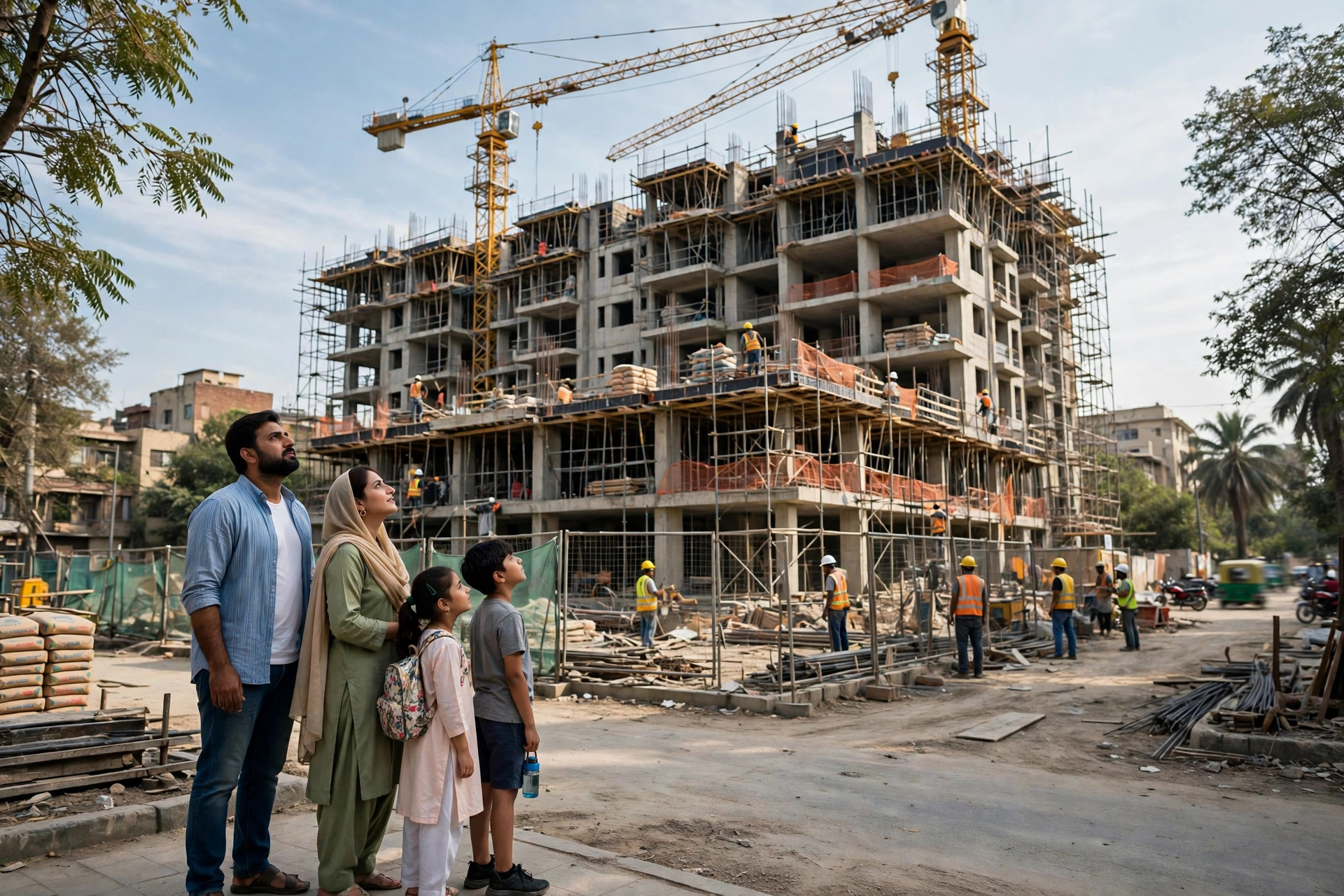
The State Bank of Pakistan (SBP) has rewritten the rules for bank lending to builders and developers for the first time in more than twelve years. The new framework — SH&SFD Circular No. 09 of 2026, dated 18 November 2026, with the revised “Guidelines for Builders/Developers Financing” enclosed for banks and DFIs to implement — replaces the guidelines issued under IH&SMEFD Circular No. 02 dated 1 April 2014. The SBP states its aim plainly: to increase the supply of mortgageable housing units and strengthen the overall housing finance ecosystem. In the guidelines’ own words, financing for creditworthy builders and developers remains a critical gap in expanding the supply of housing units — too few homes in Pakistan are built in a way a bank will accept as security for a mortgage at all.
It helps to be clear about what kind of rule this is. This is a builder-side rule, not a home-loan rule. It governs the loan a bank gives a developer to build a project — not the loan you take to buy a flat in it. Your own home loan sits under separate SBP housing-finance regulations, updated in August 2026: banks may finance up to 90% of the property value, for up to 30 years, with your total monthly loan repayments capped at 65% of net disposable income — and eligible first-time buyers can get the Apna Ghar scheme’s fixed 5% markup for the first ten years. We cover those in detail in our home loans in Pakistan guide. This circular is about a different question: whether the project you are buying into actually gets built, on time, with your instalments spent on that project and nothing else.
The Short Answer
Under the new guidelines, a builder who borrows from a bank must route all project money — booking payments, your instalments, payments to contractors — through one escrow account opened and operated jointly with the lending bank, must publicly disclose the approved layout plan and completion timeline before taking bookings or allotments, and must agree in the loan contract that if it misses its timelines or milestones, the project will be liquidated or sold to another builder to complete it, subject to legal formalities. The bank must inspect the site at least once every six months during construction, and loan drawdowns should be linked to certification by a technical consultant who checks actual progress against the agreed milestones.
None of this makes your mortgage cheaper, and none of it orders banks to lend more. What it does is go after the exact risk flat buyers in Pakistan fear most: paying instalments for years into a project that stalls, while the money has quietly gone somewhere else.
What the New Rules Require
| Area | Requirement under the 18 November 2026 guidelines |
|---|---|
| Who can borrow | REITs, public and private builders and developers — including FGEHA, PHA Foundation, provincial and territorial housing authorities, agencies and town-planning bodies, and other notified public-sector housing SPVs |
| Valuations | Up to Rs 50 million: desktop valuation by the bank/DFI itself. Above Rs 50 million and up to Rs 500 million: at least one Pakistan Banks’ Association-approved valuer. Above Rs 500 million: at least two approved valuers |
| Buyers’ money | A jointly operated escrow account is mandatory; all bookings, instalments and contractor payments pass through it, by crossed cheque; it cannot be shifted to another bank during the financing without all lenders’ consent |
| Monitoring | The bank must scrutinise or audit the project and escrow accounts, check compliance with financial covenants, and physically inspect the project at least once every six months; drawdowns should be linked to a technical consultant’s certification |
| Public timeline | The approved layout plan and project completion timeline must be publicly disclosed before bookings or allotments |
| If the builder fails | The loan agreement must state that on default in timelines, milestones or financing terms, the project will be liquidated or sold to another builder/developer for completion, subject to legal formalities |
| Insurance | Comprehensive insurance or takaful (such as a Contractor’s All Risk policy or equivalent) is required, with all policies assigned in favour of the bank/DFI |
Who Qualifies, and What the Bank Asks For
A developer must hold a valid builder/developer licence from the relevant building control authority where applicable, or an approved contract or agreement with a competent public-sector authority. Private developers must show a good track record of successfully completed projects, backed by a list of recently completed ones. The project land must have a clear title, free of encumbrance, charges and liens — and the value of that land counts as the builder’s or sponsor’s equity in the project.
The paperwork is heavy, and deliberately so. The guidelines list documents banks and DFIs may obtain, including three years of financial statements (for exposure up to Rs 500 million, audited by a practising chartered accountant or cost and management accountant; above Rs 500 million, the latest audited financials must be audited by a firm on the SBP’s panel of auditors), three years of income tax returns or assessment orders, and confidential bankers’ reports on the firm and its directors and sponsors. Project documents include clear title papers, the approved building plan (and the approved master plan for horizontal projects), permission to mortgage, a non-encumbrance certificate where applicable, the NOC for construction and sale of units, a predefined list of contractors and subcontractors, and permissions from authorities such as the Civil Aviation Authority and federal and provincial environmental protection agencies.
Before lending, the bank must also satisfy itself the project can repay. The project should be capable of generating sufficient cash flows to repay its debt; the technical feasibility report must be independently reviewed by a reputed engineering firm registered with a body such as the Pakistan Engineering Council; and a financial feasibility report endorsed by a reputed auditing firm — covering anticipated economic conditions, capital investment, financial projections and the projected completion time — is required. A legal opinion from a reputed law firm on the project and property documentation must also be sought.
How the Money Is Protected
This is the heart of the circular, and the part that matters most to someone paying instalments:
- Escrow: one account, opened and operated jointly by the borrower and the bank or DFI, expressly “to prevent diversion of funds”. Booking receipts, subsequent instalments, disbursements to contractors and subcontractors, and withdrawals for construction all pass through it under pre-agreed terms, and all payments are made by crossed cheques. In syndicated financing, the participating institutions and the borrower mutually designate which bank maintains the account.
- Repayment source: the guidelines name cash flows from down payments and instalments by individual purchasers as the primary source of repayment, so banks need to secure the loan through an assignment of project receivables. In plain terms, your instalments are part of the bank’s security — which is exactly why the bank watches them.
- Collateral: the primary security is a mortgage on the plot being built on. If the land cannot be mortgaged for reasons other than a title problem, an alternative property with clear title and no encumbrance or lien may be offered instead. A lien or mortgage may also be created over the project firm’s movable and immovable assets and registered with the Registrar of Companies, so the same security cannot be pledged to another lender. Where the borrower has no property, a bank or corporate guarantee may be taken.
- Monitoring: regular monitoring through the whole construction phase — scrutiny or audit of the project accounts and the escrow account, compliance checks on financial covenants, and physical inspection at least once every six months. A technical consultant reviews actual progress against scheduled progress and agreed milestones and flags bottlenecks; all drawdowns should be linked with the consultant’s certification. For public-sector developers, government-approved authorities may also play a monitoring role.
- Insurance: comprehensive insurance or takaful, such as a Contractor’s All Risk policy or equivalent, with all policies assigned in favour of the bank or DFI. If you want to understand how the takaful side of that works, see our takaful in Pakistan guide.
Banks and DFIs have also been encouraged to establish specialised units for expanding their developer and builder financing portfolios — an acknowledgement that this kind of lending needs dedicated teams, not just a general corporate-loan desk.
What It Means for You
- If you are buying a flat or house on instalments in a bank-financed project: ask two questions before booking — is the project financed by a bank or DFI under these rules, and where is the publicly disclosed layout plan and completion timeline? Those are now things a financed builder must produce. Pay instalments only into the project’s escrow account, by crossed cheque or another traceable instrument, and keep every receipt; that account is the paper trail if anything goes wrong. A request to pay cash, or into a dealer’s personal account, does not fit this system.
- If you are buying in a project that is not bank-financed: these rules do not cover it. The guidelines are instructions to banks and DFIs, so the protections above apply to financed projects only. The same due diligence — clear title, approvals, the builder’s completed projects — falls entirely on you.
- If you are a builder or developer: the door is more open than it was — more kinds of developers are eligible, small financings up to Rs 50 million need only a desktop valuation, and the SBP is pushing banks to build dedicated teams. The price is transparency: audited accounts, independent feasibility reviews, a joint escrow account, six-monthly inspections and a public timeline.
- If you are taking a home loan: this circular does not change your loan terms. The 90% financing, 30-year tenor and 65% debt-burden cap come from the August 2026 housing-finance regulations, and Apna Ghar’s 5% fixed rate for the first ten years is a separate government markup-subsidy scheme. What this circular can change, over time, is supply: more projects that banks are willing to finance means more units that can be bought with a mortgage in the first place. For the borrower-side rules, start with our home loans guide and the wider loans and credit cards hub.
What It Does Not Do
Be careful with the headlines. This circular does not announce a housing subsidy, does not promise cheaper mortgages, and does not order banks to lend more to developers. It sets the conditions under which banks may lend, and the safeguards that must surround the money. Whether lending actually grows depends on banks using the framework — and on the cost of borrowing. The policy rate stands at 12%, raised by 50 basis points on 26 October 2026 with effect from 27 October, going into the next Monetary Policy Committee meeting on Monday 14 December 2026. That rate sets the price of every loan in this chain, builder-side included; we explain the October decision in our SBP interest rate decision coverage.
There is also a reporting trap to avoid. Some coverage of this story mixes it up with the August 2026 individual-borrower rules (90% loan-to-value, 30-year tenor, 65% debt-burden cap) and presents those as part of this announcement. They are not: those rules were set in August, under the revised Housing Finance Prudential Regulations. The 18 November circular is the builder-side companion, and the “after 12 years” in the headlines refers to the 2014 guidelines it replaces.
What to Watch Next
- Whether banks act: the first test is whether banks announce specialised developer-finance units or financed projects under the new rules. A framework nobody uses changes nothing.
- The December MPC (Monday 14 December 2026): the policy rate sets builder borrowing costs too, so the decision will shape how much developer financing banks are willing to price. The minutes of the 26 October meeting, at which the rate was raised to 12%, are now published on the SBP website for anyone who wants to see how the committee reasoned.
- Your own purchase: if you are booking in a financed project, the published timeline and the escrow account are your two reference points — compare what you see on site against both.
Frequently Asked Questions
Does this circular change my home loan?
No. It governs loans to builders and developers. Your home loan is governed by the SBP’s housing-finance regulations (up to 90% of property value, up to 30 years, repayments capped at 65% of net disposable income) and, if you qualify, the Apna Ghar scheme.
I am paying instalments on a flat. How do I know if these rules protect me?
Only if the project is bank-financed under the new framework. Ask the builder which bank or DFI finances the project and for the publicly disclosed layout plan and completion timeline; instalments on a financed project must go through the joint escrow account, by crossed cheque.
What happens if the builder stops building?
Under the new rules the loan agreement must provide for the project to be liquidated or sold to another builder or developer for completion, subject to legal formalities. That is a contractual fallback, not a guarantee — it still depends on the bank enforcing it, and the guidelines do not set out how buyers rank against the bank if a project is liquidated.
Why did the SBP wait 12 years to update these rules?
The SBP has not said. The 2014 guidelines stayed unchanged through a decade in which housing finance barely grew; the new version is explicitly framed as fixing the supply of mortgageable units, which the SBP calls a critical gap.
Is this the same as the 90% home-loan rule I read about?
No. The 90% of property value, 30-year tenor and 65% debt-burden cap are individual-borrower rules from August 2026. This circular is the builder-side rules issued on 18 November 2026.
Disclaimer: This article is for information only and is not financial advice. Builder-financing terms depend on the bank’s assessment of the project; verify the current rules on sbp.org.pk and the financing terms with the lending bank before acting on them.
Last updated: 29 November 2026
Sources: State Bank of Pakistan, SH&SFD Circular No. 09 of 2026 dated 18 November 2026 and the enclosed revised Guidelines for Builders/Developers Financing (sbp.org.pk); SBP Housing Finance Prudential Regulations-2026, updated 18 August 2026 (sbp.org.pk); SBP Monetary Policy Statement, 26 October 2026, and the SBP’s FY27 advance calendar of MPC meetings (sbp.org.pk).

Abdul Hannan is a video editor and technical writer. He breaks down Pakistan’s banking and finance topics — savings accounts, loans, credit cards, prize bonds and taxes — into simple, practical guides at Bank Guide PK, and shares CapCut tutorials and editing guides at EditLogic.