
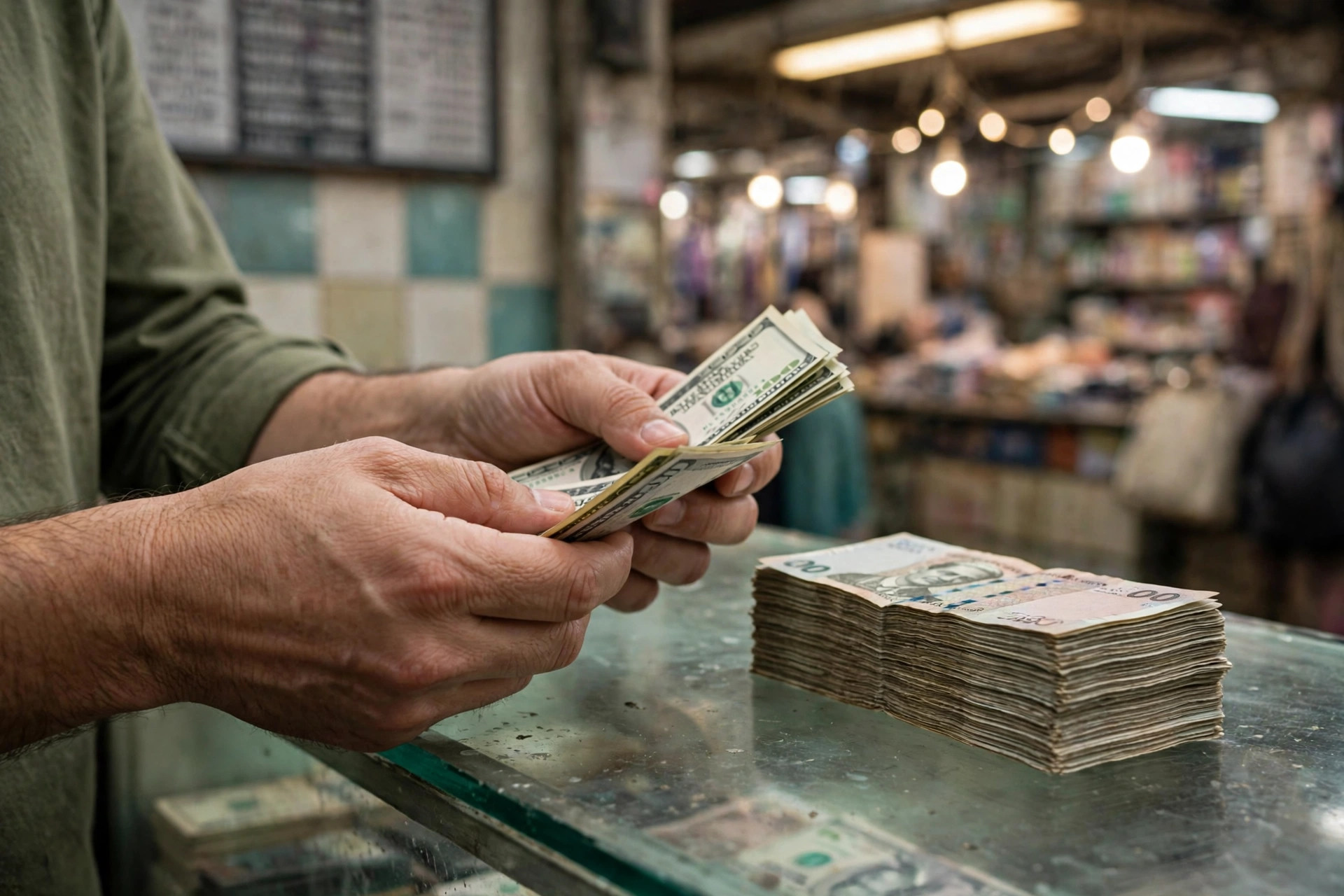
The US dollar closed at Rs 276.42 in Pakistan’s interbank market on Friday 27 November 2026 — down 3 paisa on the day, from Rs 276.45 the session before. At the same time, exchange companies in the open market closed the day buying dollars at Rs 277.25 and selling them at Rs 278.40. Three different numbers for the same dollar, all correct at the same time — because they are three different markets.
This article explains the dollar rate the way a reader actually needs it: which rate applies to you, why the open-market rate is higher, what the rupee’s unusual stability means, and how to work out what your dollars are worth before you change them or send them home.
The Dollar Rate Today — 27 November 2026
| Rate | Rs per $1 | Date / source |
|---|---|---|
| SBP reference (M2M revaluation) rate | 276.4228 | 27 Nov 2026, State Bank of Pakistan |
| Interbank weighted-average buying | 276.1102 | 27 Nov 2026, SBP |
| Interbank weighted-average selling | 276.5671 | 27 Nov 2026, SBP |
| Interbank close (reported) | 276.42 | 27 Nov 2026, down 3 paisa from 276.45 |
| Open-market buying (close) | 277.25 | 27 Nov 2026, Exchange Companies Association |
| Open-market selling (close) | 278.40 | 27 Nov 2026, Exchange Companies Association |
27 November was a Friday, so these are the latest official rates until the next working day. The interbank rate moves every working day, and the open-market rate moves through the day. Any figure here is a dated example — check the State Bank’s website or a licensed exchange company for the rate on the day you transact. What does not change daily is the structure below.
Interbank, Open Market and the SBP Rate — Three Different Things
The interbank rate is the rate at which banks trade dollars with each other, in large amounts. It is set by supply and demand between banks — importers buying dollars, exporters and remittance inflows selling them — and the State Bank publishes the day’s weighted-average buying and selling rates and a mid-market (M2M) revaluation rate. On 27 November the buying average was Rs 276.11 and the selling average Rs 276.57, a spread of about 46 paisa. This is the rate that matters for large transactions: import payments, export receipts, and the rate banks use as the benchmark for converting remittances into rupees.
The open-market rate is the cash rate at exchange-company counters — the rate you get when you walk in with rupees and buy dollar notes, or walk in with dollars and sell them. Licensed exchange companies set their own buying and selling rates from the supply and demand for cash currency, and they add a spread for their costs and risk. On 27 November the Exchange Companies Association’s closing rates were Rs 277.25 buying and Rs 278.40 selling — a spread of Rs 1.15, wider than the interbank spread, with the selling rate about Rs 1.83 above the interbank selling rate. Individual companies differ: some dealer boards quoted as high as Rs 280.00 selling the same day. Always compare two or three counters before a large exchange; the headline open-market rate is an average, not a promise.
The SBP reference rate is the one number most websites quote as “the dollar rate today”. It is the State Bank’s daily mark-to-market revaluation rate — Rs 276.4228 on 27 November — used for valuing foreign-currency positions. It is not a rate at which you can buy or sell dollars. If a converter shows you Rs 276.42, that is the reference rate; the rate you will actually get at a bank or exchange company will be a little worse, because every seller adds a spread.
Bank card rates are a fourth rate, and usually the worst of the four for the customer. When you pay in dollars with a Pakistani debit or credit card, or withdraw cash abroad, your bank converts at its own rate — typically a few percent above the interbank rate — and may add a cross-border fee on top. A $100 online purchase at the interbank rate would cost about Rs 27,642; at a card rate 3% higher, about Rs 28,471. For large or repeated foreign spending, that gap matters more than a day’s movement in the rate itself. Our best debit cards guide compares what the main banks charge for foreign transactions.
What Your Dollars Are Worth
At the 27 November interbank mid-rate of Rs 276.42:
| Amount | Rupees at interbank mid-rate |
|---|---|
| $1 | Rs 276.42 |
| $100 | Rs 27,642 |
| $500 | Rs 138,211 |
| $1,000 | Rs 276,423 |
| $10,000 | Rs 2,764,228 |
At the open-market selling rate of Rs 278.40, buying $1,000 in cash costs Rs 278,400 — Rs 1,977 more than the interbank mid-rate. Selling $1,000 in cash at the open-market buying rate of Rs 277.25 gets you Rs 277,250. The gap between buying and selling cash is the exchange company’s margin, and it is why the same $1,000 is worth a different number depending on which side of the counter you are on.
For remittances, the interbank rate is the one that counts. A family member sending $500 home from Saudi Arabia — the largest source of remittances, $981.6 million in October 2026 — converts at roughly the interbank rate, so about Rs 138,211 reaches the family before any sending-company fee. That is also why the dollar rate and the remittance story belong together: October’s $3.89 billion of remittances arrived at a rupee that barely moved, so families received the full benefit of the inflow instead of losing it to a falling rupee. Freelancers earning in dollars face the same conversion question — our freelancer international payments guide covers the cheapest ways to bring that money in.
Why the Rupee Has Barely Moved
The striking fact about the dollar rate in late 2026 is how little it moves. Over the past 90 days it has ranged only from Rs 276.42 to Rs 276.70. The longer run shows a slow strengthening:
| Date | Rs per $1 |
|---|---|
| September 2023 (peak) | ~307.09 |
| 31 December 2025 | 280.12 |
| 30 June 2026 | 278.16 |
| 30 September 2026 | 277.11 |
| 30 October 2026 | 276.75 |
| 27 November 2026 | 276.42 |
The rupee has strengthened by about Rs 3.70 against the dollar since the end of 2025 — roughly 1.3% — and by about Rs 30 since the September 2023 peak. That stability is not an accident, and it is not a peg. Several forces are pulling in the same direction at the moment:
- Remittances are strong. October 2026 brought in $3.89 billion, up 13.8% on a year ago, and $14.8 billion in the first four months of FY27. Every dollar sent home is a dollar the market does not have to find elsewhere.
- Reserves are rising. SBP-held foreign-exchange reserves rose $8 million in the week ended 20 November 2026 to $21.60 billion — the sixth consecutive weekly gain — with total liquid reserves at $26.75 billion. The State Bank expects its reserves to reach $23 billion by December 2026 and $25 billion by June 2027. Higher reserves mean the market believes the State Bank can meet dollar demand, which itself steadies the rate.
- The policy rate is high. At 12% since the 27 October 2026 hike (our SBP rate decision guide has the detail), the policy rate keeps rupee savings attractive relative to holding dollars, and it keeps a lid on import demand by keeping credit expensive.
- The trade gap is being covered. In October, remittances of $3.89 billion roughly matched the month’s merchandise trade deficit of about $3.88 billion. When inflows cover the import bill, there is little pressure on the rupee to fall.
None of this is permanent. The same rate can move the other way if remittances slow, if oil prices push the import bill up, if an IMF review stalls, or if the State Bank cuts rates faster than the market expects. Stability that depends on inflows is not the same as strength that comes from exports — a point that applies to the exchange rate just as much as to remittances.
What Moves the Rate
- Remittances and exports bring dollars in; a strong month supports the rupee.
- Imports, especially oil, take dollars out; a rise in world oil prices or in import volumes pressures the rupee down. (Oil also feeds the petrol price, which OGRA now sets daily.)
- Reserves and the IMF programme set the market’s confidence. Reserves rising for six straight weeks, as they have into late November, calm the market; a stalled review or a reserves fall does the opposite. The IMF Executive Board is expected to consider Pakistan’s reviews on 11 December, with about $1.21 billion at stake.
- The policy rate (12% now) affects how attractive rupee assets are and how much credit-fuelled import demand there is. A rate cut makes holding rupees less rewarding and can soften the currency.
- Seasonal demand — Hajj and Umrah travel, the wedding season, and year-end import orders — lifts cash-dollar demand in the open market first, which is one reason the open-market premium over interbank widens at times even when the interbank rate is flat.
How to Check the Rate — and How Not to Be Caught Out
- For the official rate, check the State Bank’s website (sbp.org.pk) for the day’s weighted-average and M2M rates. That is the benchmark; everything else is a spread on top of it.
- For cash, check the Exchange Companies Association’s open-market rates and compare at least two licensed exchange companies before a large amount. The spread between companies can be more than Rs 1.50 on the selling rate alone.
- Only use SBP-licensed exchange companies or a bank. Unlicensed dealers may quote a better rate, but the money has no paper trail — and, as with remittances, money without a banking-channel certificate has no protection if the FBR asks where it came from.
- For cards and online payments, check your own bank’s card conversion rate and any cross-border fee before a large purchase; the interbank rate you see online is not the rate your bank will charge you.
- Do not treat a daily rate as a trend. A 3-paisa move, like 27 November’s, is noise. The rupee’s 90-day range is less than 30 paisa wide. A rate that has been flat for months can still move — but one day’s quote tells you nothing about the direction.
What to Watch Next
- Early December: November’s remittance figure, due around 9–10 December. October set a high bar at $3.89 billion — watch whether November holds above $3.5 billion.
- Thursday 3 December: the SBP’s weekly reserves statement, covering the week ended 27 November. Six straight weekly gains have taken SBP reserves to $21.60 billion; the December target is $23 billion.
- 11 December: the IMF Executive Board meeting on Pakistan’s reviews, with about $1.21 billion in disbursements expected if approved.
- 14 December: the next SBP monetary policy decision. The policy rate is 12%; any signal on the rate path moves both the rupee and deposit rates.
- Oil prices: they move the import bill and the petrol price together. A sustained rise would be the most direct threat to the rupee’s calm.
Frequently Asked Questions
What is the dollar rate in Pakistan today?
Rs 276.42 in the interbank market at the 27 November 2026 close (SBP M2M rate Rs 276.4228), and Rs 277.25 buying / Rs 278.40 selling in the open market at the close. The rate changes every working day — check sbp.org.pk for the current figure.
Why is the open-market dollar rate higher than the interbank rate?
The interbank rate is what banks charge each other for large, non-cash trades. The open market is cash at a counter: exchange companies add a spread for their costs, cash handling and risk, so the selling rate runs about Rs 1–3 above interbank. The spread varies by company and by day.
Why has the rupee been so stable?
Strong remittances ($3.89 billion in October), rising SBP reserves ($21.60 billion), a 12% policy rate, and inflows that roughly cover the trade deficit have all supported it. The 90-day range is only Rs 276.42–276.70.
How many rupees is $100?
About Rs 27,642 at the 27 November interbank mid-rate; about Rs 27,725 if you sell $100 in cash at the open-market buying rate, and about Rs 27,840 to buy $100 in cash at the open-market selling rate.
Is it a good time to buy dollars?
This article does not give investment advice. The rate has been flat for months, which means timing the market has paid little either way — but the spread you pay at the counter (Rs 1.15 between buying and selling cash at the 27 November close, and more at some counters) is a certain cost, while any future move in the rate is not.
Does the dollar rate affect remittances?
Yes, directly: money sent home converts at roughly the interbank rate, so a stable rupee means families receive the full rupee value of what was sent. See our remittances guide for how to receive money from abroad, and our Roshan Digital Account guide if you are an overseas Pakistani who wants to hold or invest dollars in Pakistan.
Disclaimer: This article is for information only and is not financial advice. Exchange rates change every working day — the Rs 276.42 / Rs 277.25 / Rs 278.40 figures are the 27 November 2026 rates only. Confirm the current rate on sbp.org.pk or with your bank or a licensed exchange company before acting on it.
Last updated: 29 November 2026 — SBP M2M revaluation rate 276.4228, weighted-average bid 276.1102 / offer 276.5671, interbank close Rs 276.42 (down 3 paisa from Rs 276.45), all 27 November 2026, from the State Bank of Pakistan’s daily rates (sbp.org.pk) as published in the SBP’s daily exchange rate sheet and its official social post; open-market close buying Rs 277.25 / selling Rs 278.40 on 27 November from the Exchange Companies Association of Pakistan, with dealer boards up to Rs 277.30 / Rs 280.00 the same day noted as company variation; 90-day range Rs 276.42–276.70 and historical points (30 Oct 276.75, 30 Sep 277.11, 31 Dec 2025 280.12, 30 Jun 2026 278.16, Sep 2023 peak ~307.09) from the SBP rate history as compiled in November 2026 reporting; reserves SBP $21,595m (+$8m, sixth weekly gain), banks $5,154.5m, total $26,749.5m, week ended 20 Nov 2026, from the SBP weekly statement released 26 November 2026; reserves outlook $23bn Dec 2026 / $25bn Jun 2027 from Governor Jameel Ahmed’s 26 October 2026 press conference; remittance figures from the SBP press release of 10 November 2026; October trade deficit ~$3.88bn from Pakistan Bureau of Statistics figures (exports $2.93bn, imports $6.81bn) as reported in November 2026; policy rate 12% w.e.f. 27 October 2026 from the SBP Monetary Policy Statement of 26 October 2026 (sbp.org.pk); IMF Executive Board meeting expected 11 December 2026 (about $1.21bn) as reported 24–25 November 2026. The card-rate example (3% above interbank) is illustrative, not a verified bank figure — check your own bank’s card rate sheet before a large foreign payment. Re-verify all rates on sbp.org.pk before publishing — the rate will already be stale the next working day.

Abdul Hannan is a video editor and technical writer. He breaks down Pakistan’s banking and finance topics — savings accounts, loans, credit cards, prize bonds and taxes — into simple, practical guides at Bank Guide PK, and shares CapCut tutorials and editing guides at EditLogic.